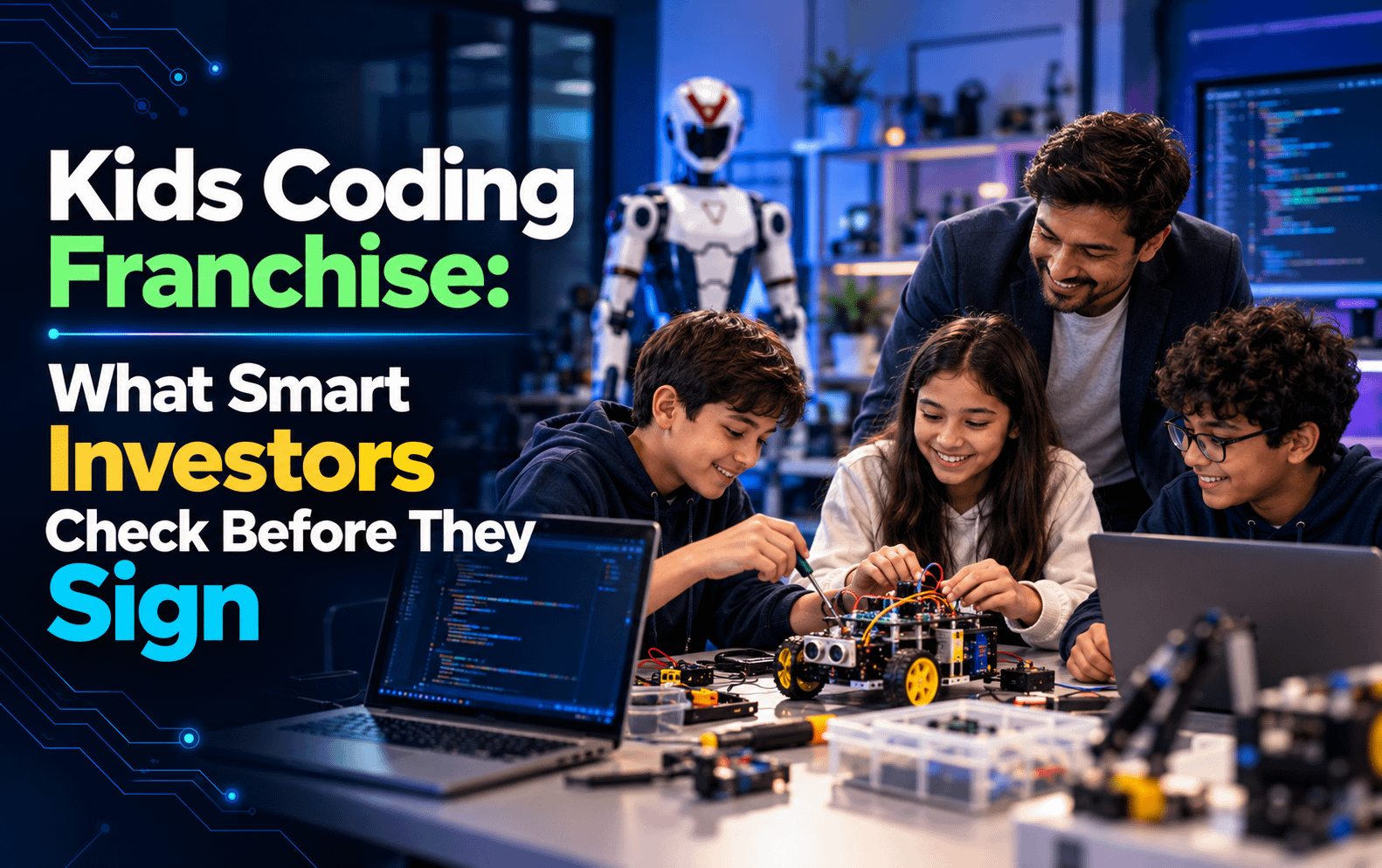
Every investor conversation in 2026 seems to circle back to the same word: AI. Automation headlines get all the attention. But a quieter trend matters more for long-term investors. As AI reshapes the workforce, kids need to genuinely understand technology, not just consume it. That demand is accelerating fast. It’s exactly why STEM-focused education franchises are drawing serious investor interest right now.
Humanoid robots have also gone from research-lab novelty to daily headlines in just a couple of years. Parents are rethinking what “future-ready” actually means for their kids. Investors who spot that shift early can back a brand already positioned inside it. That’s a very different opportunity than the traditional after-school tutoring model from a decade ago. The businesses built around that shift look less like a niche hobby program and more like infrastructure for the next generation.
The AI Boom Is Making STEM Education a Necessity, Not a Trend
For years, schools and parents treated coding and robotics classes as enrichment, something nice to have alongside soccer practice and piano lessons. That framing is quickly becoming outdated. Artificial intelligence now handles more of the routine work of writing and debugging code. That shift makes the people who can direct, evaluate, and build on top of that code more valuable, not less.
iCode’s own franchise blog makes this case directly in Why Learn to Code When AI Can Write Code? Understanding the logic behind software lets a person use AI tools effectively instead of losing out to them.
For an investor, that distinction matters. A trend-driven business is fragile. A business built around a foundational skill tends to hold up across economic cycles. Reading and math instruction have represented that kind of skill for generations. Parents increasingly treat STEM and coding education the same way: not optional, but expected.
Education Franchises Are Attracting a New Wave of Investors
A Necessity-Driven, Recession-Resilient Category
Franchise investors have always valued categories where demand doesn’t evaporate when the economy tightens. Parents cut back on plenty of discretionary spending during a downturn. But they resist cutting anything tied to their child’s education and future readiness. That’s part of what makes after-school and enrichment education attractive. It sits closer to a necessity than a luxury in most household budgets.
Recognized as One of the Fastest-Growing Education Companies in America
This isn’t just theory for iCode. Financial Times recently ranked the brand #1 in Education and #111 overall among the fastest-growing companies in North and South America. That recognition reflects real, measurable expansion, not marketing language. For an investor evaluating a franchise system, third-party validation matters. Outside analysts are tracking and confirming the brand’s growth independently.
What Sets iCode Apart From Other STEM Franchise Opportunities
Education franchises don’t all follow the same formula. What makes iCode unique comes down to curriculum depth, hands-on technology, and a business model that welcomes owners who aren’t necessarily technologists themselves.
A Proprietary, STEM.org-Accredited Curriculum
An in-house curriculum team keeps iCode’s STEM.org-accredited curriculum continuously updated. That matters for two reasons. It keeps the program credible with parents who are comparing options. And it means franchise owners don’t have to build or source content on their own. Students work with real coding languages, robotics platforms, and project-based learning instead of static worksheets.
Hands-On Technology Kids Actually Want
The classroom experience leans into what’s currently capturing kids’ attention: robotics, game development, drones, and increasingly, humanoid robotics and AI-adjacent programming. That relevance drives enrollment and re-enrollment. It’s a meaningfully different pitch to parents than a generic after-school program.
The Humanoid Robotics Wave Is Reaching After-School Education
Humanoid robots have moved from research demos to daily news coverage faster than almost anyone predicted. That cultural moment is trickling down into what kids ask their parents about. A handful of iCode campuses have already added advanced, mentor-led humanoid robotics programming to their course offerings. Students get hands-on experience programming a real humanoid robot instead of just reading about one.
For an investor, the robot itself isn’t the point. It represents something bigger: a brand that keeps its curriculum current with where technology is actually heading, instead of teaching the same fixed program year after year. That ongoing relevance keeps enrollment, and word-of-mouth referrals, moving in the right direction.
The Financial Picture Investors Actually Care About
Revenue Streams Built for Year-Round Cash Flow
A single-season business model is a hard sell to most investors. That’s why iCode’s revenue streams span after-school programs, camps, virtual learning, and off-site school partnerships. That diversification keeps enrollment and cash flow moving through the school year and the summer. Revenue doesn’t concentrate into one short window.
Revenue Potential
iCode’s own revenue potential data tells a strong story. The brand’s highest-grossing campus generated $1,148,757 in a recent year. The top quartile of campuses averaged $566,365 in gross revenue. Over a third of that quartile exceeded the benchmark.
The same page cites an industry-wide growth rate of roughly 16% annually for education franchise opportunities between 2023 and 2030. That trajectory lines up with the broader push toward technology and AI literacy in schools.
Startup Investment and the iCode Expenditure Guarantee
On the cost side, iCode designed its startup investment model to be transparent from day one. Owners can build and equip a state-of-the-art, multi-classroom facility starting as low as $249,000.
iCode also guarantees that most line items in that estimate won’t exceed the amounts disclosed upfront. That guarantee removes one of the more common sources of investor anxiety: cost overruns partway through buildout.
Financing Support
Some investors don’t want to fund the full investment out of pocket. iCode outlines financing options that help qualified candidates open a location without covering the entire cost from cash reserves alone.
A Business Model Built for Non-Technical Owners
Many prospective franchisees assume they need to be a coder themselves to run a coding franchise. iCode deliberately built its innovative business model around the opposite assumption. Instructors deliver the curriculum. Owners run the business.
iCode structures training, marketing support, and operational guidance so a motivated investor without a technical background can still run a location successfully. The FAQ addresses this point directly.
Territory Availability Is Narrowing
Not every market stays open indefinitely in a growing franchise system. iCode’s available territories page reflects the current state of open markets across the country. As the brand continues its Financial Times-recognized growth trajectory, the list of attractive, unclaimed territories keeps shrinking.
Investors in this category generally do better moving early in a market they want. Waiting too long usually means someone else claims the territory first.
What Current Franchisees Say
Numbers only tell part of the story. iCode’s franchisee testimonials and the reasons parents love iCode point to the same pattern. Owners describe the business as more than a financial investment. Parents describe re-enrolling their kids year after year.
Satisfied families drive repeat and referral enrollment. That pattern supports the year-over-year revenue growth the brand has reported.
Is Now the Right Time to Invest in a STEM Franchise?
There’s rarely a perfectly obvious moment to invest in anything. Timing rarely feels certain, and investors who wait for perfect certainty often wait too long. But the current mix of factors deserves serious attention. AI is accelerating demand for genuine technical literacy in kids. The after-school education category has historically held up well through economic uncertainty. iCode specifically holds third-party recognition as one of the fastest-growing companies in its category.
Investors want a business tied to a need that keeps growing, not fading. This category, and this brand, deserve a closer look.
Next Steps for Serious Investors
iCode’s next steps page walks through the process from first conversation to grand opening. It answers the most frequently asked questions along the way.
Investors typically move forward with at least $100,000 in liquid capital and a net worth of $500,000. The best way to find out how your specific situation fits is to talk directly with the franchise development team.
Does the case for a future-ready education franchise make sense to you? The next move is simple.
Request information, and a member of the iCode franchise development team will follow up. They’ll walk through territory availability, investment details, and what ownership actually looks like day to day.
Categories tied to a shift as large as AI and automation don’t stay under the radar for long. Investors who look closely now are best positioned to claim a territory before it’s gone.